
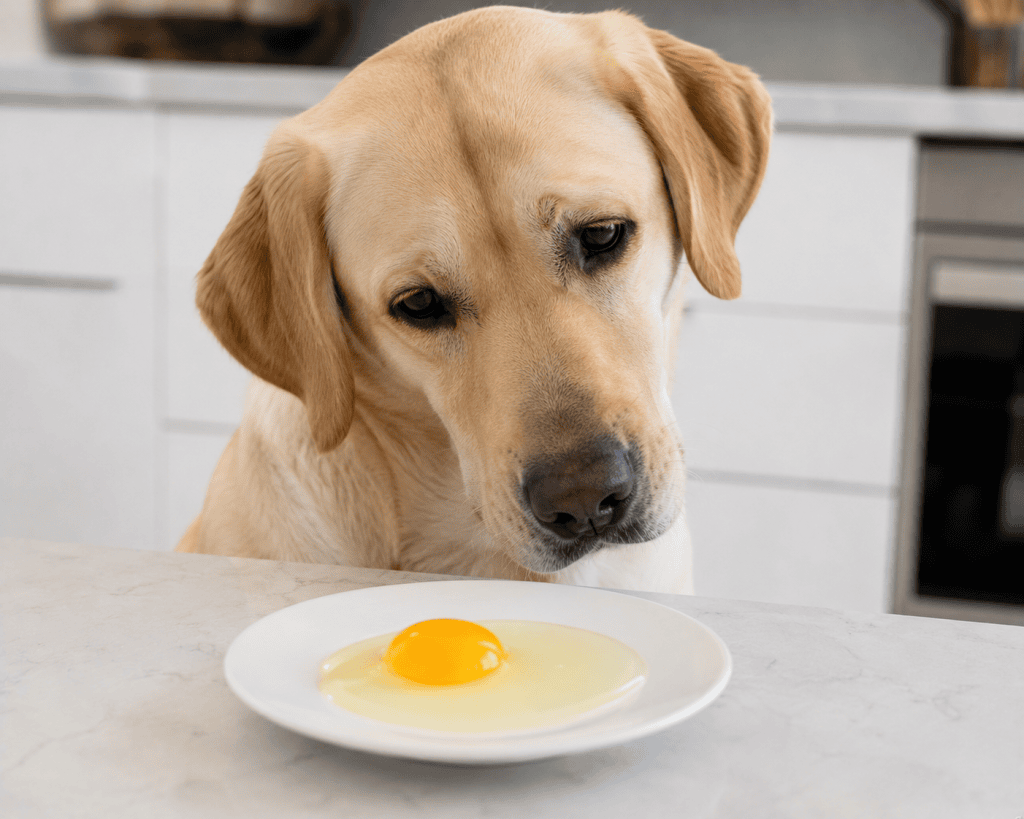
This is one of the more genuinely divided questions in canine nutrition ‘ can dogs eat a raw egg’, and we’ll give you an honest answer rather than a simple one. The official veterinary position from the FDA, AVMA, and AKC is that raw eggs are not recommended for dogs — primarily due to Salmonella risk and a nutritional concern around biotin absorption. The raw feeding community argues that raw eggs are a natural, nutritious food that dogs have been eating throughout their evolutionary history.
Table of Contents
The honest position is that a single raw egg given occasionally to a healthy adult dog is unlikely to cause serious harm — but cooked eggs provide virtually identical nutritional benefits with none of the risks. There is no compelling reason to give raw eggs when the safer alternative is so straightforwardly better.
Here’s the complete picture.
What’s in an Egg — Why They’re Nutritious
Before getting to the raw vs cooked debate, it’s worth establishing why eggs are genuinely valuable for dogs:
Complete High-Quality Protein
Eggs are one of the most biologically complete protein sources available — so complete that egg protein is the reference standard against which all other dietary proteins are measured. A single large egg contains around 6 grams of complete protein with all essential amino acids in highly bioavailable form. The AKC confirms that eggs are a great source of protein for dogs.
Healthy Fats
Egg yolks contain healthy unsaturated fats alongside saturated fats, providing slow-release energy and supporting the absorption of fat-soluble vitamins A, D, E, and K.
Vitamins A, D, E, and B12
Vitamin A supports vision, skin condition, and immune function. Vitamin D supports calcium absorption and bone health. Vitamin E is a fat-soluble antioxidant supporting cell membrane integrity. Vitamin B12 is essential for neurological function and red blood cell production.
Biotin (Vitamin B7)
Biotin is present in egg yolks in significant amounts. It supports healthy skin, coat condition, digestion, metabolism, and normal cell function. This is directly relevant to the raw egg discussion — and the reason why feeding whole raw eggs is considered less problematic than feeding raw egg whites alone.
Selenium and Riboflavin
Selenium is an antioxidant mineral supporting thyroid and immune function. Riboflavin (B2) supports energy metabolism and healthy growth.
Choline
Choline supports healthy liver function, brain health, and cognitive development — particularly relevant for puppies and senior dogs.
The Two Risks of Raw Eggs
Risk 1 — Salmonella
The FDA’s Centre for Veterinary Medicine is clear: cooking eggs effectively destroys Salmonella and other pathogens that pose risks to both pets and humans. Raw eggs can carry Salmonella regardless of how fresh they appear.
The AKC’s Chief Veterinary Officer, Dr. Jerry Klein DVM, states directly: feeding raw eggs to dogs has the same risks as people eating raw eggs.
Salmonellosis — the infection caused by Salmonella — produces symptoms in dogs including:
- Vomiting
- Diarrhoea (sometimes bloody)
- Fever
- Lethargy
- Loss of appetite
- Dehydration
Most healthy adult dogs who encounter Salmonella have enough immune resilience to fight off the infection without serious illness. However, puppies, senior dogs, immunocompromised dogs, and dogs receiving immunosuppressive medication are significantly more vulnerable.
The zoonotic transmission risk is equally important. The AKC confirms that dogs who eat raw eggs can shed Salmonella in their saliva, faeces, and on surfaces — posing a genuine transmission risk to humans in the household, particularly to children, elderly people, and immunocompromised individuals. A dog that appears completely healthy after eating a raw egg may still shed Salmonella in a way that affects human household members.
This public health dimension — not just the individual dog’s health — is part of why the FDA, AVMA, and mainstream veterinary guidance recommends against raw eggs.
Risk 2 — Avidin and Biotin Interference
Raw egg whites contain a protein called avidin — a glycoprotein that binds very tightly to biotin (vitamin B7) and prevents its absorption in the gut. The Tufts Clinical Nutrition Service (2021) specifically notes that chronic ingestion of raw egg whites can lead to biotin deficiency, manifesting as dermatitis, hair loss, and poor growth.
This is an important nuance: the risk is primarily from raw egg whites fed regularly, not from whole raw eggs fed occasionally.
Here’s why:
- Avidin is in the egg white
- Biotin is concentrated in the egg yolk
- When a dog eats a whole raw egg (white and yolk together), the biotin in the yolk partially counteracts the avidin’s blocking effect
- The risk of genuine biotin deficiency from whole raw eggs given occasionally is low for most healthy adult dogs
- The risk increases significantly when raw egg whites are fed alone, frequently, or over extended periods
Cooking completely neutralises avidin — it is denatured by heat, eliminating the biotin interference entirely. PetMD confirms that cooking eggs neutralises avidin, making them a safer and more nutritious choice for dogs.
The Raw Feeding Argument — Honestly Presented
The BARF and raw feeding community makes several points in favour of raw eggs:
- Dogs have a more acidic stomach environment than humans, which provides some protection against bacterial pathogens including Salmonella
- Raw eggs have been part of canine diets throughout evolutionary history — dogs are not physiologically “designed” for cooked food
- The nutrients in raw eggs — particularly enzymes — are partially degraded by cooking
- Many raw feeders report excellent coat condition, energy levels, and digestive health in dogs that receive raw eggs as part of a properly formulated raw diet
- The biotin deficiency risk from whole raw eggs (as opposed to egg whites alone) is low when the full egg is consumed
These are legitimate observations. The raw feeding community is not wrong that dogs have some additional protection against Salmonella compared to humans, and that whole raw eggs present a meaningfully lower biotin risk than egg whites alone.
However — the AVMA and FDA’s position is based on the population-level risk, not the individual case. A raw egg given to a healthy adult dog probably will not cause harm. But “probably” is not “certainly,” and cooked eggs provide essentially the same nutritional value without the risk.
The Definitive Answer — Cook the Egg
The Tufts Clinical Nutrition Service makes the key point clearly: cooking denatures avidin, preserving biotin availability and improving overall nutrient absorption, and cooking eggs effectively destroys Salmonella.
PetMD confirms that cooked eggs are the safer and more nutritious choice — with nearly identical protein and nutrient content to raw eggs, minus the risks.
The AKC’s position: most veterinarians recommend cooking eggs fully before feeding them to your dog.
The practical conclusion: cooked eggs are better than raw eggs in every meaningful way for dogs. The nutritional difference between raw and cooked is marginal — a slight reduction in some heat-sensitive vitamins — while the safety difference is meaningful. There is no scenario in which raw eggs are preferable to cooked eggs for a dog, unless the dog is part of a properly formulated raw feeding programme under veterinary guidance.
If you want to give your dog an egg — cook it. Plain, no butter, no oil, no salt, no seasoning. Scrambled or hard-boiled. That’s the recommended approach from the AKC, PetMD, Purina, and Tufts.
How to Prepare Eggs Safely for Dogs
Hard-boiled — the simplest option. Boil until fully set (around 10 minutes), cool completely, peel, slice or mash, serve plain. No shell preparation needed unless you specifically want to use the eggshell (see below).
Scrambled — cook in a dry non-stick pan without any butter, oil, salt, or seasoning. Plain scrambled egg, fully cooked through with no wet or runny sections, cooled before serving.
Poached (plain) — poached in plain water without any vinegar or seasoning additives. Fully cooked, no runny yolk, cooled before serving.
Never: fried (too much added fat), cooked with butter or oil (pancreatitis risk), cooked with salt (sodium overload), cooked with garlic or onion (toxic to dogs), or served runny/undercooked (Salmonella risk remains).
What About Eggshells?
Eggshells are a rich natural source of calcium carbonate — approximately 2 grams of calcium per eggshell. PetMD confirms that dogs can eat eggshells when prepared properly. The preparation matters:
- Bake or boil the eggshells to kill any pathogens on the surface
- Grind to a fine powder using a food processor or coffee grinder — whole or large pieces of shell are a choking hazard and can scratch the oesophagus
- Sprinkle a small amount over regular food — a quarter teaspoon of eggshell powder provides approximately 800mg of calcium
Eggshell powder is a useful calcium supplement for dogs on home-prepared diets where calcium balance is a specific consideration. For dogs on complete commercial food, additional calcium supplementation is not generally needed and can cause problems if overdone — consult your vet before adding eggshell powder to the diet of a dog already eating complete dog food.
How Much Egg Can a Dog Have?
The AKC confirms that eggs are nutrient-dense and relatively high in calories — one large egg contains around 70 to 80 calories. The 10% daily calorie rule applies.
Practical guidance:
- Small dogs (under 10kg) — half an egg, a few times a week
- Medium dogs (10–25kg) — one whole egg, a few times a week
- Large dogs (over 25kg) — one to two eggs, a few times a week
Do not give eggs daily to small dogs — the calorie load adds up quickly. A few times per week as a treat or food topper is the appropriate frequency for most dogs.
Can Puppies Have Raw Eggs?
No — puppies are not recommended to eat raw eggs. The AKC is explicit: puppies have immature immune systems and are more susceptible to Salmonella infection, making raw eggs a higher-risk food for them. Cooked egg is perfectly appropriate for puppies and is an excellent protein-rich food topper — plain, fully cooked, no seasoning.
Can Senior Dogs Have Raw Eggs?
Not recommended. Senior dogs, particularly those with any immunocompromising conditions, are more vulnerable to Salmonella. Cooked egg is the right choice for older dogs — all the nutritional benefit, none of the risk.
Can Dogs Be Allergic to Eggs?
Yes — Dr. Jerry Klein DVM, Chief Veterinary Officer of the AKC, confirms that some dogs have food allergies or sensitivities to eggs. Signs include:
- Vomiting or diarrhoea after egg consumption
- Persistent itching, particularly around paws and ears
- Recurring ear infections
- Skin rashes or hot spots
If you’re introducing eggs for the first time, start with a small amount of cooked egg and monitor for 48 hours before offering more. Stop immediately and consult your vet if any reaction occurs.
The One-Egg-Fell-on-the-Floor Scenario
This is the most common real-world situation — a raw egg cracks on the kitchen floor and the dog laps it up before you can do anything. In a healthy adult dog, this single exposure is unlikely to cause serious harm. Monitor for 24 to 48 hours for any signs of digestive upset — vomiting, diarrhoea, lethargy, fever. Contact your vet if symptoms develop or if the dog is a puppy, senior, or has any health condition.
The Bottom Line
Raw eggs are not recommended for dogs by the FDA, AVMA, and AKC — primarily due to Salmonella risk (including zoonotic transmission to humans) and the avidin/biotin concern with regular feeding of egg whites. A single whole raw egg given occasionally to a healthy adult dog is unlikely to cause serious harm, but there is no good reason to give raw when cooked is safer, equally nutritious, and just as easy to prepare.
Cooked eggs — plain, fully cooked, no butter, oil, salt, or seasoning — are one of the best natural treat and food topper additions you can give a dog. Scrambled or hard-boiled, they are nutritionally excellent, highly digestible, and loved by the vast majority of dogs.
Cook the egg. Your dog gets everything they need and you eliminate every meaningful risk.
Frequently Asked Questions
Can dogs eat a raw egg? Not recommended — the FDA, AVMA, and AKC all advise against raw eggs for dogs due to Salmonella risk and the biotin-blocking effect of avidin in raw egg whites. A single accidental exposure in a healthy adult dog is unlikely to cause serious harm, but cooked eggs are the better choice.
Is a raw egg better than a cooked egg for dogs? No — cooked eggs provide virtually identical nutritional benefits with none of the Salmonella or avidin risks. There is no proven nutritional advantage to raw eggs over cooked eggs for dogs.
Can dogs eat raw egg yolk? The yolk is the safer part of a raw egg — it contains the biotin that counteracts some of the avidin in the white. However, the Salmonella risk applies to the whole egg including the yolk. Cooked egg yolk is nutritionally excellent and free of risk.
Can dogs eat raw egg white? Not recommended — raw egg whites alone carry both the Salmonella risk and the highest avidin concentration. Regular feeding of raw egg whites can cause genuine biotin deficiency over time.
How often can dogs have cooked eggs? A few times per week as a treat or food topper is appropriate for most healthy adult dogs. Adjust frequency based on your dog’s size — eggs are calorie-dense and small dogs need proportionally smaller portions.
Can puppies eat eggs? Cooked eggs — yes, an excellent protein-rich food topper for puppies. Raw eggs — no, puppies’ immature immune systems make them more vulnerable to Salmonella.
Sources:
- American Kennel Club — most veterinarians recommend cooking eggs before feeding to dogs; Salmonella risk for dogs and owners; feeding raw eggs has the same risks as people eating raw eggs; Dr. Jerry Klein DVM, AKC Chief Veterinary Officer (akc.org): https://www.akc.org/expert-advice/nutrition/can-dogs-eat-eggs/
- PetMD — raw eggs can carry Salmonella causing vomiting, diarrhoea, and dehydration; avidin in raw egg whites interferes with biotin absorption; cooking neutralises avidin making eggs safer and more nutritious (petmd.com): https://www.petmd.com/dog/nutrition/can-dogs-eat-eggs
- US Food and Drug Administration (FDA) — Centre for Veterinary Medicine: cooking eggs effectively destroys Salmonella and other pathogens posing risks to both pets and humans; dogs can act as carriers shedding bacteria without clinical illness (fda.gov)
- American Veterinary Medical Association (AVMA) — formally advises against feeding raw foods including raw eggs to pets due to bacterial pathogen risk (avma.org): https://www.avma.org/resources-tools/avma-policies/raw-or-undercooked-animal-source-protein-companion-animal-diets
- Tufts Clinical Nutrition Service (2021) — chronic ingestion of raw egg whites can lead to biotin deficiency manifesting as dermatitis, hair loss, and poor growth; cooking denatures avidin preserving biotin availability (vet.tufts.edu)
For more guides on safe protein sources for dogs, see our Can Dogs Eat Beef? and Can Dogs Eat Canned Salmon? articles — or browse our Adult Dog Treats section for our top natural treat recommendations. Head to our full Can Dogs Eat series for more guides on safe and unsafe foods for dogs.