
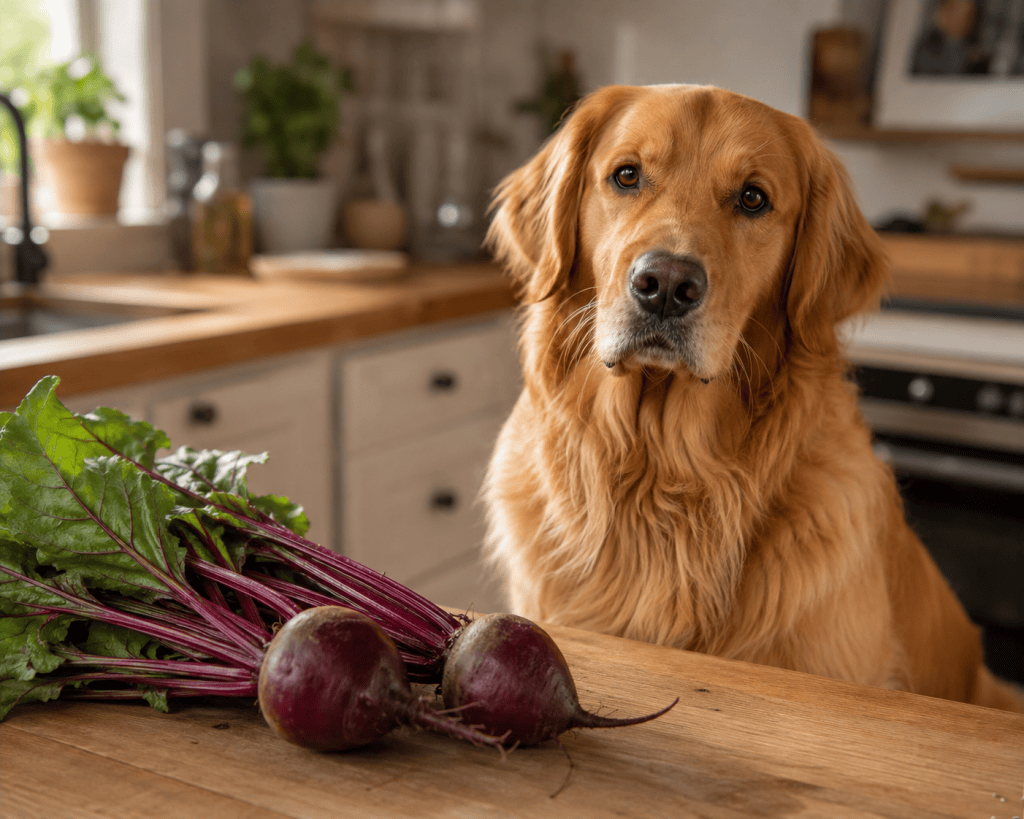
Explore the health advantages and digestive considerations behind Can Dogs Eat Beets, plus tips for preparing them safely Yes — dogs can eat beets (also known as beetroot in the UK), and fresh, plain beets offer genuine nutritional benefits including fibre, vitamins, minerals, and powerful antioxidant pigments. PetMD confirms that beets can be fed either cooked or raw and are not toxic to dogs. Dr. Dwight Alleyne DVM, a veterinarian at JustAnswer, confirms that dogs can safely eat most types of beets when properly prepared.
Table of Contents
However, beets come with two specific considerations that require attention: an oxalate content that makes them unsuitable for dogs with a history of kidney or bladder stones, and a natural pigment that turns urine and faeces bright red or pink — which can be alarming if you don’t know to expect it. Neither of these is a reason to avoid beets for healthy dogs, but both are worth understanding before you serve them.
Beets vs Beetroot — The Same Vegetable
A quick regional clarification:
- Beets — the term used in the US, Canada, and Australia
- Beetroot — the term used in the UK, Ireland, and much of Europe
Both refer to Beta vulgaris — the same root vegetable. All guidance in this article applies equally to both terms.
Are Beets Good for Dogs?
Fresh beets offer a genuinely useful nutritional profile:
Dietary Fibre
PetMD confirms that the fibre in beets is good for dogs — supporting healthy digestion, regular bowel movements, and gut microbiome health. Beets contain both soluble and insoluble fibre, making them useful for maintaining digestive regularity.
Vitamins C and B9 (Folate)
Vitamin C supports immune function and acts as an antioxidant. Folate supports healthy cell production and red blood cell formation — particularly relevant for puppies and pregnant dogs.
Potassium and Magnesium
Potassium supports heart function, nerve signalling, and muscle development. Magnesium supports energy production, bone health, and mineral absorption. Both present in useful amounts in fresh beets.
Betalains — The Standout Antioxidant
This is beets’ most distinctive nutritional feature and one that distinguishes them nutritionally from most other vegetables. Betalains are a group of potent antioxidant pigments — betacyanins (responsible for the vivid red-purple colour) and betaxanthins (present in yellow beets). Research in human nutrition has documented significant anti-inflammatory and antioxidant properties from betalain consumption.
For dogs, the anti-inflammatory potential of betalains is particularly relevant for older dogs or breeds prone to joint inflammation. Betalains are also the compounds responsible for the red urine and stool discolouration that can occur after eating beets — more on this below.
Manganese
Manganese supports enzyme function, carbohydrate metabolism, and bone development. Present in useful amounts per serving of beets.
The Honest Caveat
PetMD provides an important reality check: although the fibre in beets is good for dogs, the high carbohydrate content and natural sugars are not ideal, and beets are high in oxalic acid which can cause crystals and stones throughout the urinary tract. Beets are a nutritious occasional treat — not a vegetable to be given daily or in large amounts.
The Red Urine and Stool Warning — Not Blood
This is something almost every dog owner who feeds beets for the first time encounters, and it causes genuine alarm.
The betalain pigments in beets — specifically betacyanin — are not broken down during digestion in the way most pigments are. They pass through the digestive system intact and are excreted in urine and faeces, turning them bright red or pink. This is called beeturia in humans and the same phenomenon occurs in dogs.
Dr. Dwight Alleyne DVM is clear: due to a pigment in beets called betanin, it is possible to change the colour of a dog’s faeces after eating beets, though it is not likely to affect the colour of the urine significantly in all dogs.
This discolouration is harmless. It is purely cosmetic — the result of pigment passing through the digestive system, not blood. It typically resolves within 24 to 48 hours after the beet has fully passed through.
However — if your dog shows red or bloody stool at any time when they have not eaten beets, this is a different matter entirely and should be assessed by a vet immediately. Knowing your dog has eaten beets before attributing red stool to beeturia is important.
The Oxalate Concern — The Main Risk
Beets contain significant levels of oxalic acid — the same naturally occurring compound covered in our Can Dogs Eat Baby Spinach? guide. Oxalates can interfere with calcium absorption and, in susceptible dogs, contribute to the formation of calcium oxalate crystals and kidney or bladder stones.
PetMD is explicit: if your dog is prone to oxalate crystals in the urine or oxalate stones, your veterinarian may recommend avoiding beets altogether. Cornell University College of Veterinary Medicine notes that calcium oxalate urinary stones are one of the most common urinary tract conditions in dogs, and dietary management — including limiting high-oxalate foods — is an important part of managing susceptible dogs.
For healthy dogs with no urinary history, the oxalate content in appropriate portions of beet given occasionally is not a significant concern — their kidneys can process and excrete normal oxalate loads without problem.
For at-risk dogs, beets should be avoided without explicit veterinary approval:
- Dogs with a history of calcium oxalate bladder or kidney stones
- Dogs with chronic kidney disease
- Dogs with recurrent urinary crystal episodes
- Breeds with documented elevated urinary stone susceptibility: Miniature Schnauzers, Yorkshire Terriers, Lhasa Apsos, Bichon Frises, and Miniature Poodles
Beet Root vs Beet Tops (Leaves) — An Important Distinction
Dr. Dwight Alleyne DVM is clear on this point: while the root of the beet is safe for dogs to eat, the tops (leaves/greens) should not be fed to dogs because they contain higher concentrations of oxalates than the root itself, which can contribute to the formation of bladder or kidney stones.
This is an important practical distinction for anyone growing their own beets or buying them with the greens attached — the deep purple-red leaves may look appealing and nutritious, but they carry a significantly higher oxalate load than the root. Stick to the root only and dispose of the leaves.
Pickled Beets — Never
Pickled beetroot — the vinegar-soaked, jarred variety found in every supermarket — is not appropriate for dogs under any circumstances. It contains:
- High levels of salt — creating sodium overload risk
- Vinegar — acidic and irritating to the digestive system
- Sugar — often added to sweet pickled varieties
- Spices and preservatives — various additives not appropriate for dogs
The Merck Veterinary Manual documents sodium ion poisoning as a serious and potentially fatal condition in dogs. The sodium content of typical pickled beetroot is well beyond what is appropriate for any dog. Always fresh, always plain.
Canned Beets — Also Avoid
Canned beets present the same sodium and preservative concerns as pickled varieties. PetMD advises using fresh beets and avoiding canned or processed forms. Even “no added salt” canned beets often contain more sodium than the fresh equivalent, and some contain vinegar or citric acid. Fresh beets prepared at home are always the better option.
Raw vs Cooked Beets — Both Are Fine
Raw beets — safe when peeled, washed thoroughly, and cut into small appropriately sized pieces. PetMD confirms raw beets can be given to dogs, though most pet owners prefer cooked. Raw beets are quite hard and dense — a choking hazard for small dogs and harder to digest than cooked. Grate or finely dice raw beets for small dogs. Peel before serving to remove pesticide residue.
Steamed beets — the best cooking method. Steaming retains the most nutritional value while softening the texture for easier digestion. Serve plain, cooled to room temperature.
Boiled beets — safe and soft, though some nutritional value is lost to the cooking water. Fine if that’s the preparation method available.
Baked beets — safe if plain, without oil, salt, or seasoning.
Never: cooked with oil, butter, garlic, onion, salt, or any seasoning. Never pickled, canned, or processed.
How Much Beet Can a Dog Have?
The 10% daily calorie guideline applies. Given beets’ sugar content — higher than most vegetables in this series — moderation is more important than with lower-sugar options like courgette or cucumber.
PetMD-consistent serving guidance:
- Small dogs (under 10kg) — 1 teaspoon of grated/finely diced beet, a few times a week
- Medium dogs (10–25kg) — 1 to 2 tablespoons, a few times a week
- Large dogs (over 25kg) — 2 to 3 tablespoons, a few times a week
Once or twice a week is the appropriate frequency for most healthy adult dogs. Beets are not a vegetable to add to every meal.
Introduce very gradually — start with a very small amount and monitor over 24 to 48 hours for any digestive reaction before offering more. The combination of fibre and sugar can cause loose stools in dogs with sensitive digestion if introduced too quickly.
Can Puppies Eat Beets?
With caution — small amounts of cooked, plain beet in small pieces are unlikely to cause harm in healthy puppies. However, puppies’ developing digestive systems are more sensitive to high-fibre, higher-sugar foods, and their kidneys are more susceptible to oxalate stress. Given that safer, simpler vegetable options exist (carrot, courgette, cucumber), there is no pressing reason to introduce beets to a puppy’s diet. If you do, start with the smallest possible amount of cooked beet and monitor carefully.
Can Senior Dogs Eat Beets?
With the usual caveats. Senior dogs with reduced kidney efficiency are more susceptible to oxalate accumulation, and older dogs prone to urinary issues should have beets cleared with their vet first. For healthy senior dogs without kidney concerns, small amounts of plain cooked beet given occasionally are not a concern. The anti-inflammatory betalain content may offer some modest benefit for senior dogs with joint stiffness.
The Sugar Content — Diabetic Dogs
Beets have one of the higher natural sugar contents of commonly fed dog vegetables — around 6.8 grams of sugar per 100 grams. This is not a problem in small occasional amounts for healthy dogs, but it is a meaningful consideration for:
- Diabetic dogs — avoid beets or clear with vet first
- Overweight dogs — factor the sugar content into daily calorie management
- Dogs on prescription diets — check with vet before adding any new food
How to Prepare Beets for Your Dog
Step 1: Wash thoroughly under cold running water to remove surface soil and pesticide residue.
Step 2: Peel — the skin can retain pesticide residue and is harder to digest than the flesh. Always peel before serving.
Step 3: Cook (recommended) — steam or boil until tender, cool completely.
Step 4: Prepare — cut into small, appropriately sized pieces for your dog’s size. For small dogs, grate or mash. For medium to large dogs, dice into 1-2cm cubes.
Step 5: Serve plain — mixed into regular food or as a standalone treat. No salt, no oil, no seasoning.
Never: serve beet with its leaves, pickled, canned, or cooked with any human seasoning.
How to Serve Beets
As a food topper — a teaspoon to tablespoon of cooked, diced beet mixed into regular food adds colour, nutritional variety, and mild sweetness. Most dogs accept it readily.
As a standalone treat — small pieces of cooked beet served as an occasional treat. The sweetness makes them palatable to most dogs.
Grated raw — for healthy adult dogs without digestive sensitivity, finely grated raw beet mixed into food is a reasonable approach. Always peel first.
Mashed — mashed cooked beet mixed into food as a topper. Particularly useful for dogs with dental issues or older dogs who prefer soft food.
Signs Your Dog Has Had Too Many Beets
- Loose stools or diarrhoea
- Gas or bloating
- Vomiting
- Red or pink urine/stool (if not already expecting this — see beeturia section above)
Mild symptoms should resolve within 24 hours. Reduce the amount given going forward. Contact your vet if symptoms are severe or persistent, or if your dog shows any signs of urinary discomfort (straining, frequent urination, blood in urine separate from beeturia) in the days following beet consumption.
The Bottom Line
Beets are safe and nutritious for most healthy adult dogs in small amounts given occasionally — confirmed by PetMD and Dr. Dwight Alleyne DVM. The fibre, vitamins, potassium, and particularly the betalain antioxidants offer genuine value. The oxalate content, sugar content, and high-sodium risk from pickled or canned forms are the considerations that require appropriate management.
The rules are straightforward: fresh only, peeled, plain, cooked where possible, root only (not the leaves), and never pickled or canned. The red urine and stool effect is harmless but worth knowing about in advance — it catches many first-time beet-feeding dog owners completely off guard.
Frequently Asked Questions
Can dogs eat beetroot? Yes — fresh, plain beetroot is safe for dogs in small amounts. The root is safe; the leaves are not recommended due to higher oxalate content. Avoid pickled, canned, or seasoned varieties.
Why is my dog’s poo red after eating beets? The betalain pigments in beets pass through the digestive system intact and are excreted, turning urine and stool red or pink. This is called beeturia and is completely harmless. It resolves within 24-48 hours. Red stool in a dog that has not eaten beets should be assessed by a vet.
Can dogs eat pickled beetroot? No — pickled beetroot contains high levels of salt, vinegar, and often sugar and spices. None of these are appropriate for dogs. Fresh, plain beetroot only.
Are beets safe for dogs with kidney stones? Not without veterinary guidance — beets contain oxalates that can contribute to calcium oxalate stone formation in susceptible dogs. Dogs with a history of urinary stones should avoid beets or have them cleared with a vet first.
Can dogs eat raw beets? Yes — raw beets are safe when peeled, washed, and cut into small pieces. Cooked beets are easier to digest and are the more commonly recommended form.
Can dogs eat beet leaves/tops? No — Dr. Dwight Alleyne DVM specifically advises against feeding beet tops to dogs as they contain higher concentrations of oxalates than the root and can contribute to kidney or bladder stone formation.
Sources:
- PetMD — beets can be fed cooked or raw and are not toxic to dogs; fibre in beets is good for dogs; high carbohydrate content, natural sugars, and oxalic acid are concerns; if prone to oxalate crystals or stones, vet may recommend avoiding beets (petmd.com): https://www.petmd.com/dog/nutrition/can-dogs-eat-beets
- Dr. Dwight Alleyne DVM, veterinarian at JustAnswer — dogs can safely eat most types of beets; avoid feeding the green tops as they contain oxalates contributing to bladder or kidney stones; betanin pigment can change colour of dog’s faeces after eating beets (rover.com): https://www.rover.com/blog/can-my-dog-eat-beets/
- Cornell University College of Veterinary Medicine — calcium oxalate urinary stones are one of the most common urinary tract conditions in dogs; dietary management including limiting high-oxalate foods is important for susceptible dogs (vet.cornell.edu)
- Merck Veterinary Manual — sodium ion poisoning documented as a serious and potentially fatal condition in dogs; high-sodium foods including pickled vegetables are a significant risk (merckvetmanual.com)
- ASPCA Animal Poison Control Center — oxalates confirmed as contributing to bladder stone formation in susceptible pets; general vegetable safety framework (aspca.org)
For more vegetable treat guides, see our articles on Can Dogs Eat Baby Spinach? and Can Dogs Eat Courgette? — or browse the full Can Dogs Eat series for more guides on safe and unsafe foods for dogs.