
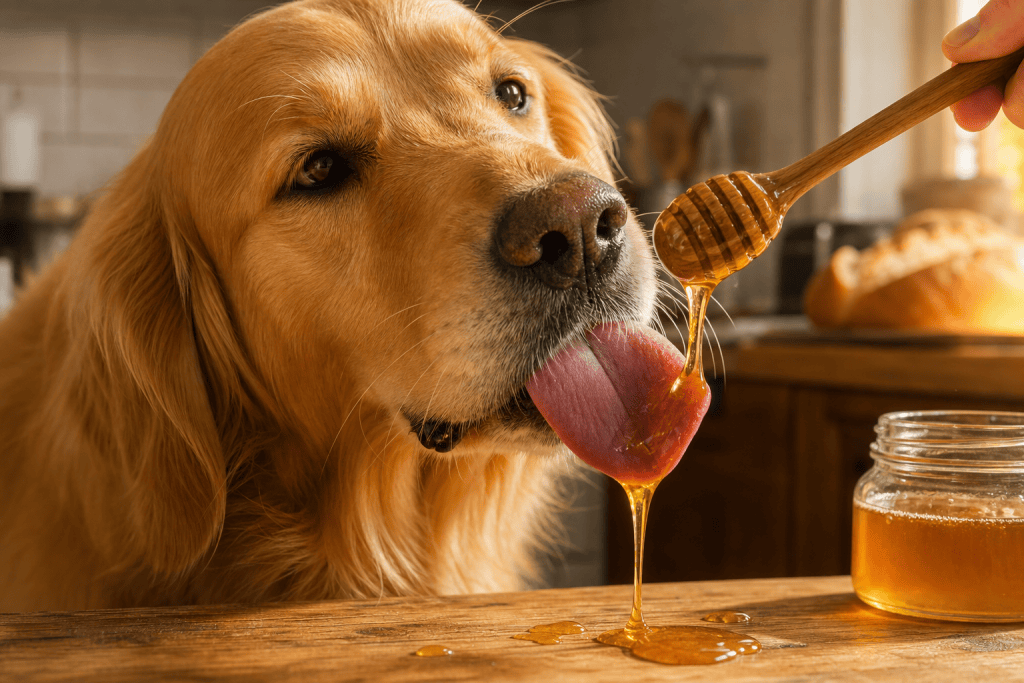
If you’re wonderng can dogs have honey and if so, how much, read on. Yes — honey is safe for healthy adult dogs in small amounts, and both the AKC and PetMD confirm this. Honey is non-toxic, contains natural sugars alongside trace vitamins and minerals, and has genuine antibacterial and anti-inflammatory properties that have made it a subject of veterinary interest. The AKC even notes that honey can help soothe minor sore throats and inflammation in dogs alongside veterinary treatment.
Table of Contents
However, honey has two specific risk factors that require understanding: a botulism concern that makes it completely off-limits for puppies under 12 months, and a high sugar content that makes it inappropriate for diabetic dogs, overweight dogs, and dogs with dental disease. Beyond these well-defined exclusions, a small amount of good-quality honey given occasionally to a healthy adult dog is a genuinely acceptable natural treat.
Is Honey Nutritious for Dogs?
Honey is primarily sugar — around 80% natural sugars (glucose and fructose) by composition. It also contains trace amounts of:
- Vitamins — small amounts of vitamins C, B6, niacin, riboflavin, and folate
- Minerals — calcium, copper, iron, magnesium, manganese, phosphorus, potassium, and zinc
- Antioxidants — flavonoids and phenolic acids that help reduce oxidative stress
- Prebiotics — naturally occurring compounds that support beneficial gut bacteria
- Antimicrobial compounds — including hydrogen peroxide and defensin-1, which give honey its documented antibacterial properties
PetMD confirms that honey contains natural sugars along with trace amounts of vitamins and minerals. The honest assessment: the nutritional contribution at treat-level portions (a quarter to half a teaspoon) is modest. The sugar content is the primary component, and the trace nutrients are not present in amounts that would justify giving honey for nutritional reasons alone. Honey’s value for dogs lies more in its antimicrobial and soothing properties than in its vitamin or mineral content.
The Botulism Warning — Puppies and Immunocompromised Dogs
This is the most important safety point about honey and it is non-negotiable.
Raw honey can contain spores of Clostridium botulinum — the bacterium that causes botulism. These spores are different from active botulinum toxin — they are dormant forms that become dangerous only when they germinate and produce toxin in the right environment.
The AKC is explicit: raw honey should not be fed to puppies or dogs with compromised immune systems, as it may contain botulism spores.
In healthy adult dogs, the mature immune system and established gut flora can handle Clostridium botulinum spores without allowing them to germinate into active toxin-producing bacteria. This is why adults — human and canine — generally tolerate raw honey without botulism risk.
In puppies under 12 months, the immune system is not fully developed and the gut flora that competes with Clostridium botulinum is not yet established. In this environment, ingested spores can germinate and produce botulinum toxin — causing botulism, a potentially fatal neurological disease.
Symptoms of botulism in dogs include:
- Muscle weakness progressing to paralysis
- Difficulty swallowing
- Laboured breathing
- Loss of coordination
- In severe untreated cases, respiratory failure and death
The rule is absolute: no honey of any kind — raw or pasteurised — for puppies under 12 months.
For pasteurised honey specifically: the pasteurisation process kills most bacteria but does not reliably destroy Clostridium botulinum spores. Pasteurised honey is considered lower risk than raw honey for this reason, but the AKC’s guidance encompasses all honey types for puppies and immunocompromised dogs.
Dogs with compromised immune systems — including those undergoing chemotherapy, dogs on long-term immunosuppressive medication, and dogs with serious systemic illness — should also avoid honey. Consult your vet if your dog’s immune status is uncertain.
The Sugar and Dental Concerns
One teaspoon of honey contains approximately 20 calories and 6 grams of sugar. This is the highest sugar density of any food covered in the “Can Dogs Have” series — higher per gram than fruit, starchy vegetables, or any other natural treat option.
Dental implications — the AKC specifically recommends brushing your dog’s teeth after feeding honey. The sticky, sugary nature of honey creates an ideal environment for oral bacteria that cause tooth decay and gum disease. Dogs with existing dental disease should not receive honey. Cornell University College of Veterinary Medicine confirms that dental disease is the most common health condition in dogs — anything that accelerates oral bacterial growth is a meaningful concern.
Weight gain — at 20 calories per teaspoon, honey adds up quickly in a small dog’s daily calorie allowance. The AKC confirms that the high sugar content of honey can lead to obesity in dogs if fed too much without adequate exercise and balanced nutrition.
Diabetic dogs — never. The AKC is explicit: honey should not be given to diabetic dogs. The natural sugars cause blood glucose spikes that are dangerous in dogs with diabetes. This applies regardless of the amount.
Overweight dogs — not recommended. The calorie and sugar density makes honey a poor treat choice for dogs on calorie-restricted diets.
Raw Honey vs Pasteurised Honey vs Manuka Honey
Raw honey — unprocessed, retains the full antimicrobial compound profile, antioxidants, and enzymes. Carries the botulism spore risk discussed above. For adult dogs without immune concerns, raw honey in small amounts is appropriate and provides the most complete nutritional and medicinal profile.
Pasteurised honey — heat-treated to kill most bacteria and extend shelf life. The pasteurisation process destroys some of the beneficial enzymes and antioxidants, reducing the potential medicinal value. Lower botulism spore risk than raw honey. The most commonly available form in supermarkets.
Manuka honey — from New Zealand, produced by bees foraging on Manuka bush (Leptospermum scoparium). Contains methylglyoxal (MGO) in significantly higher concentrations than regular honey, giving it documented superior antimicrobial properties. Dial A Vet notes that Manuka honey is particularly noted for its antibacterial properties and is used in some veterinary wound care applications. It is also significantly more expensive than regular honey. For oral consumption as a treat, regular raw honey provides comparable benefit at a fraction of the cost. Manuka’s therapeutic advantage is most relevant for topical wound care applications.
Artificial honey / honey blends — avoid. Processed honey products and honey-flavoured syrups often contain added sugar, artificial flavourings, and sometimes high-fructose corn syrup. Only genuine single-ingredient honey is appropriate.

Potential Benefits — Honestly Assessed
Soothing minor sore throats and kennel cough — this is honey’s most credibly supported use for dogs. The AKC specifically endorses honey for soothing inflammation in dogs with sore throats, always alongside veterinary treatment for the underlying cause. The antimicrobial and anti-inflammatory properties of honey provide genuine comfort for mild throat irritation. Half a teaspoon of raw honey given to a dog with kennel cough is a widely used and largely evidence-supported home comfort measure.
Wound care (topical) — medical-grade Manuka honey is used in some veterinary wound management protocols. The antimicrobial and wound-healing properties are well documented. This is a distinct application from oral consumption — if considering topical honey use for a wound, consult your vet. Never apply honey to deep wounds or serious injuries without veterinary guidance.
Allergy support (local honey) — a widely held belief is that feeding local raw honey exposes dogs to small amounts of local pollen, gradually desensitising them to seasonal allergens. Dial A Vet is honest about this: some pet owners and veterinarians believe raw local honey can help reduce seasonal allergies in dogs by exposing them to small amounts of local pollen. However, scientific evidence is limited. This remains an anecdotally popular but scientifically unproven use of honey for dogs. It is not a replacement for veterinary allergy assessment and treatment.
Gut health — the prebiotic compounds in honey may support beneficial gut bacteria. The contribution at treat-level portions is modest but real.
How Much Honey Can a Dog Have?
Given the high sugar content, portion control is essential. The following is consistent with AKC and PetMD guidance:
- Extra-small dogs (under 5kg) — 1/8 teaspoon, once or twice a week
- Small dogs (5–10kg) — 1/4 teaspoon, once or twice a week
- Medium dogs (10–25kg) — 1/2 teaspoon, once or twice a week
- Large dogs (25–45kg) — 1 teaspoon, once or twice a week
- Giant breeds (over 45kg) — up to 1.5 teaspoons, once or twice a week
Never daily. The sugar content accumulates and dental risk increases with frequency. The 10% daily calorie guideline applies — one teaspoon of honey at 20 calories represents a meaningful portion of a small dog’s daily treat allowance.
How to Give Honey to Your Dog
Directly from a spoon — the simplest approach. Offer a small amount on a spoon or lick mat. Follow with fresh water and ideally tooth brushing.
Mixed into food — stirred into plain Greek yogurt, mashed banana, or regular food as a flavour addition.
On a lick mat — a small amount spread on a lick mat provides enrichment alongside the treat.
In a Kong — a thin smear inside a Kong alongside other dog-safe ingredients. A little goes a long way given the sweetness and flavour intensity.
For kennel cough comfort — half a teaspoon given directly, warmed slightly to thin it if the honey has crystallised, once or twice daily alongside veterinary treatment.
What to Do If Your Dog Ate a Large Amount of Honey
Healthy adult dog, large amount of regular honey: Monitor for digestive upset — loose stools, vomiting, lethargy. Ensure fresh water is available. The sugar content may cause temporary digestive disturbance. Contact your vet if symptoms are severe or persistent.
Puppy under 12 months — any amount of raw honey: Contact your vet immediately. Monitor for signs of botulism — weakness, difficulty swallowing, and breathing difficulties. Do not wait for symptoms.
Diabetic dog: Contact your vet. Blood glucose monitoring may be required.
The Bottom Line
Honey is safe for healthy adult dogs in small, infrequent amounts — confirmed by the AKC and PetMD. The antimicrobial and soothing properties give it genuine practical value, particularly for dogs with minor kennel cough or throat irritation. The sugar content makes it a treat to be given occasionally rather than regularly, with tooth brushing afterwards and no place in the diet of diabetic, overweight, or dentally compromised dogs.
The puppy rule is absolute: no honey before 12 months. And for adult dogs, raw honey from a reputable source in appropriate amounts is the best form — retaining the full beneficial compound profile while staying well within safe sugar limits.
Frequently Asked Questions
Can dogs have honey? Yes — healthy adult dogs can have honey in small amounts. The AKC and PetMD both confirm this. Not appropriate for puppies under 12 months, diabetic dogs, or immunocompromised dogs.
Can puppies have honey? No — never for puppies under 12 months. Raw honey contains Clostridium botulinum spores that a puppy’s developing immune system cannot adequately manage.
Is Manuka honey better for dogs? For topical wound care, Manuka honey’s higher MGO content provides superior antimicrobial properties. For oral consumption as a treat, regular raw honey provides comparable benefit at much lower cost.
Can honey help dogs with kennel cough? Half a teaspoon of raw honey can help soothe throat inflammation associated with kennel cough — endorsed by the AKC for this use alongside veterinary treatment for the underlying cause.
Can dogs have honey every day? Not recommended — the sugar content and dental risk make daily feeding inappropriate. Once or twice a week in appropriate portions is the correct frequency.
Can dogs have local honey for allergies? Some vets believe local raw honey may help with seasonal allergies. Scientific evidence is limited. Consult your vet for evidence-based allergy management rather than relying on honey alone.
Sources:
- American Kennel Club — honey is safe for dogs in small amounts; not for puppies or dogs with compromised immune systems due to botulism spores; not for diabetic dogs; can help soothe sore throats alongside veterinary treatment; brush teeth after feeding honey (akc.org): https://www.akc.org/expert-advice/nutrition/can-dogs-eat-honey/
- PetMD — honey is safe for healthy adult dogs in small quantities; contains natural sugars and trace vitamins and minerals; raw honey not for puppies under 12 months due to botulism risk; not for immunocompromised or diabetic dogs (petmd.com): https://www.petmd.com/dog/nutrition/can-dogs-eat-honey
- Dial A Vet — Manuka honey particularly noted for antibacterial properties and used in some veterinary wound care; local raw honey believed by some vets to help with seasonal allergies but scientific evidence is limited; adult dogs generally safe with small amounts; puppies should not have honey (dialavet.com): https://www.dialavet.com/blog/can-dogs-eat-honey
- Cornell University College of Veterinary Medicine — dental disease is the most common health condition affecting dogs; sticky high-sugar foods including honey increase oral bacterial growth and accelerate dental disease risk (vet.cornell.edu)
For more natural treat guides, browse our Adult Dog Treats section — or head to our full Can Dogs Eat series for more guides on safe and unsafe foods for dogs.