
Learn the truth about Can Dogs Eat Turkey Bones and why veterinarians warn against giving cooked or raw turkey bones to pets.
This is one of the most genuinely divided questions in veterinary nutrition — and we’ll give you an honest answer rather than a simple one. The official position from the FDA, AVMA, and PetMD is that no bones of any kind should be given to dogs, including raw turkey bones. The raw feeding community and many experienced raw feeding practitioners take the position that raw poultry bones — including turkey necks, wings, and backs — are appropriate for dogs when given under the right conditions.
Table of Contents
What separates raw turkey bones from other raw bones is that poultry bones are structurally different from large mammal bones. Turkey bones are thinner, more hollow, and more prone to splintering even in their raw state — which is why the veterinary debate around raw turkey bones is more cautious than the debate around large raw beef bones.
Here is the complete picture, so you can make an informed decision for your own dog.
Why Raw Turkey Bones Are Different from Cooked Turkey Bones
The most important distinction in this article is raw vs cooked — and we’ll start there because it’s the non-negotiable foundation.
Cooked turkey bones — never, without exception. Cooking makes poultry bones brittle by removing moisture and altering the collagen structure. Cooked turkey bones shatter into sharp fragments that lacerate the mouth, throat, stomach, and intestinal wall. This is a position of complete veterinary consensus. See our Can Dogs Eat Turkey? guide for the full cooked bone safety detail.
Raw turkey bones — the more complex picture covered in this article. Raw bones retain their natural moisture and have some degree of flexibility. They do not become as immediately dangerous as cooked bones. However, turkey bones are thinner and more hollow than large mammal bones, and they do carry splinter risk even when raw — particularly in aggressive chewers.
The Official Veterinary Position — No Bones of Any Kind
PetMD’s guidance, reviewed by Dr. Krystal Dickinson DVM, states clearly: dogs cannot eat turkey bones. Both cooked and raw turkey bones can splinter, leading to choking, punctures, or intestinal blockages. This represents the conservative mainstream veterinary position — that the risks of raw turkey bones are not justified by their benefits.
Purina’s veterinary team takes the same position: bones can act as a choking hazard, especially if they splinter in the dog’s mouth, and recommends avoiding bones entirely in favour of dog-approved chew alternatives.
The FDA warns that raw bones carry bacteria including Salmonella and E. coli, posing a risk not only to the dog but to humans in the household. The AVMA formally advises against feeding raw meat or bones to pets.
This is a genuine and evidence-based position. Raw turkey bones do present real risks, and there are many vets — particularly emergency vets who see the consequences of bone ingestion — who take the “no bones ever” stance based on clinical experience.
The Raw Feeding Position — Context and Conditions
The AKC acknowledges the other side of this debate: some dog owners choose to feed their dogs raw, meaty bones in consultation with their vet, and raw turkey necks are a common choice for this purpose. The AKC recommends talking with your vet about raw meaty turkey bones to understand the possible risks and benefits for your specific dog.
The Whole Dog Journal — a well-respected independent veterinary publication — notes that raw bones, when appropriately sized and given under supervision, maintain scent and flavour, support dental health, and provide genuine enrichment. The distinction between raw and cooked is the most important safety variable, not whether bones are given at all.
Experienced raw feeding practitioners, including many veterinarians with raw feeding expertise, use raw turkey necks, wings, and backs as standard components of appropriately formulated BARF diets. These bones are soft enough to be chewed and consumed rather than merely gnawed, and when properly matched to the dog’s size and given under supervision, are considered appropriate raw meaty bones.
Turkey Bones vs Beef Bones — Why Poultry Is More Complicated
The reason raw turkey bones attract more caution than large raw beef marrow bones is structural. Understanding this distinction helps make sense of the divided veterinary opinion.
Large beef bones (femur, marrow bones, knuckle bones) — dense, thick-walled, weight-bearing bones from a large animal. When raw, they retain significant flexibility and resistance. They are classified as recreational bones — too hard and dense to be fully consumed, used primarily for chewing.
Recreational Bones For Dogs
Natural recreational bones are a healthy, instinct‑satisfying treat for dogs. They help keep teeth clean and white by naturally scraping away plaque as your dog chews. Rich in essential minerals and free from artificial additives, these bones support overall health while providing long‑lasting mental stimulation. Chewing also helps relieve stress and encourages natural behaviors, making recreational bones a wholesome and enriching addition to your dog’s routine.
Check on AmazonTurkey bones — thin-walled, partially hollow, from a much smaller animal. The structural properties that make them appropriate for flight (in wild turkey ancestors) also make them more fragile under chewing pressure. Even raw, certain turkey bones — particularly the breast bones, spine, and smaller wing sections — can splinter under heavy chewing pressure from larger breeds or power chewers.
The raw turkey bones most widely accepted by the raw feeding community are the softer, more pliable ones:
Safer raw turkey bones (relatively):
- Turkey necks — the most commonly recommended. Soft, primarily cartilage with soft bone, appropriate for medium to large dogs. Provide excellent dental benefit from the chewing action
- Turkey wings — appropriate for larger dogs. The wing tip section is the softest and most appropriate for smaller dogs
- Turkey backs/carcasses — used in raw feeding as frame bones, with meat and cartilage attached. Appropriate for larger dogs under supervision
Higher risk raw turkey bones:
- Drumstick bones — the leg bones. Thicker than wing bones but still hollow and prone to splintering in aggressive chewers. Not recommended
- Breast bones and ribcage — thin, fragile, high splinter risk even when raw. Avoid
- Thigh bones — can be appropriate for larger dogs but require careful supervision
The Conditions Under Which Raw Turkey Bones Are Considered Appropriate
If you decide to give raw turkey bones, the following conditions are not optional — they are the framework within which raw poultry bones can be given with acceptable risk management:
1. Always raw, never cooked. This is the absolute non-negotiable foundation. If the bone has been cooked in any way — roasted, boiled, smoked, or heated — it is not safe.
2. Match bone size to dog size. A turkey neck appropriate for a Labrador is not appropriate for a Chihuahua. The bone must be large enough relative to the dog’s size that swallowing whole is impossible, but soft enough that the dog can work through it with normal chewing.
3. Supervise throughout. Never leave a dog alone with any bone. Supervision allows you to intervene if the dog is breaking off large pieces, if the bone is splintering unexpectedly, or if the dog is showing signs of distress.
4. Know your dog’s chewing style. Power chewers who crunch through hard objects quickly are more likely to generate dangerous fragments from any bone. Dogs who chew methodically and work through food carefully are better candidates. If your dog tends to gulp food rather than chew it, no bone of any kind is appropriate.
5. Source from reputable suppliers. Buy raw turkey bones from a butcher or pet food supplier with good food safety practices. Source fresh, handle hygienically, and keep refrigerated.
6. Food safety protocol. Wash hands after handling. Clean all surfaces the bone contacts. Dispose of the bone if it has been left at room temperature for more than an hour. Keep immunocompromised household members, young children, and elderly people separated from the dog during and after bone consumption.
7. Consult your vet. The AKC’s recommendation to talk with your vet about raw turkey bones before introducing them is the right approach. A vet who knows your dog’s health history, dental condition, and digestive sensitivity is best placed to advise whether raw turkey bones are appropriate for your specific animal.
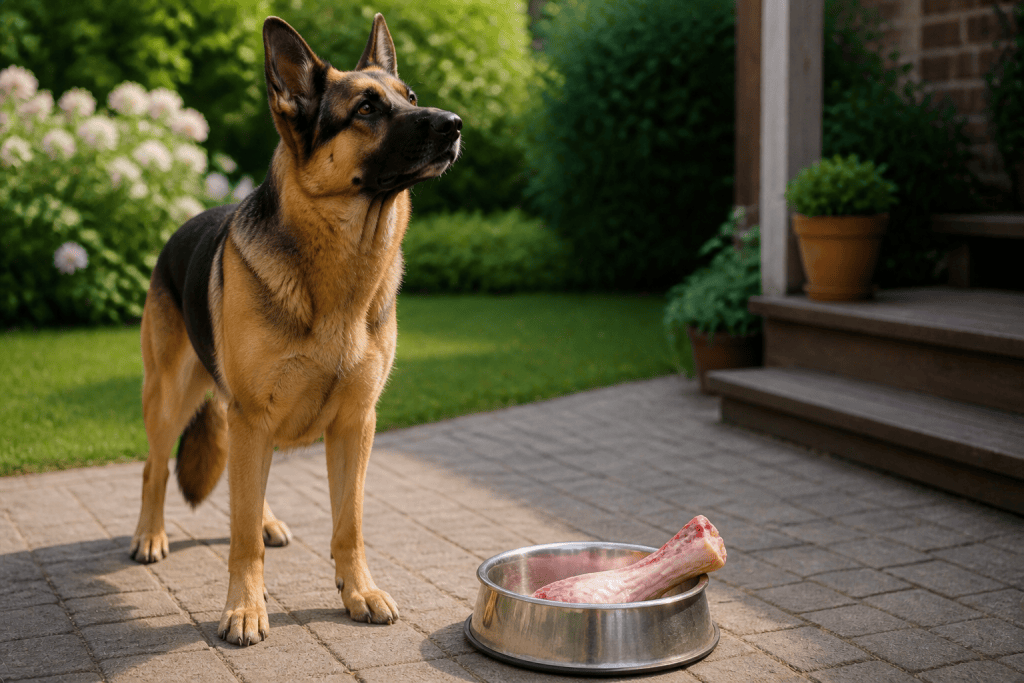
Dogs Who Should Not Have Raw Turkey Bones
Raw turkey bones are not appropriate for every dog. The following categories should not be given raw turkey bones without explicit veterinary guidance:
- Dogs with a history of intestinal blockage or foreign body ingestion
- Dogs who gulp food rather than chew it
- Aggressive power chewers who crush through hard objects
- Puppies under six months — developing teeth and smaller airways increase risk
- Senior dogs with significant dental disease or weakened teeth
- Immunocompromised dogs — bacterial contamination risk is elevated
- Dogs with known digestive sensitivity or inflammatory bowel disease
- Households with immunocompromised human members, young children, or elderly people where bacterial transmission is a significant concern
Raw Turkey Necks — The Most Commonly Used Option
Raw turkey necks deserve specific discussion as they are the most widely used raw turkey bone in natural and BARF feeding programmes.
Turkey necks consist primarily of vertebrae, cartilage, and a relatively small amount of bone — making them softer and more digestible than wing or leg bones. For medium to large dogs, a whole raw turkey neck is a widely accepted natural chew and raw meaty bone that provides:
- Sustained chewing activity
- Meaningful dental plaque reduction from the chewing action
- Protein and collagen from the meat and connective tissue
- Calcium and phosphorus from the bone
For small dogs, turkey necks may be too large and a chicken neck is more size-appropriate. Always supervise and remove the neck if the dog is attempting to swallow large sections whole rather than chewing through it progressively.
What to Do If Your Dog Ate a Raw Turkey Bone
A raw turkey neck or wing, chewed normally — healthy adult dog: Monitor for 24 to 48 hours. Provide access to fresh water. Mild digestive changes are possible but serious harm is unlikely if the bone was consumed in its raw state and the dog chewed it normally.
A raw turkey bone swallowed largely whole, or signs of gulping: Contact your vet immediately. A large piece of bone swallowed without being chewed creates a meaningful blockage risk regardless of whether it was raw.
Any signs of distress after bone consumption: Contact your vet immediately. Signs of concern include vomiting, difficulty swallowing, pawing at the mouth, drooling, lethargy, abdominal pain, difficulty defecating, or blood in stool.
Do not induce vomiting at home without veterinary instruction. Bone fragments can cause additional damage on the way back up.
Safer Alternatives for Dogs Who Love Chewing
For owners who prefer to avoid the complexity of raw turkey bones entirely, the following natural chew options provide comparable dental and enrichment benefits with a cleaner risk profile:
Bully sticks — fully digestible, high protein, long-lasting. One of the most universally recommended natural chew alternatives.
Yak chews — very hard-wearing, fully digestible, excellent for moderate to aggressive chewers.
Raw beef marrow bones (recreational) — for larger dogs, raw beef femur and knuckle bones provide the raw bone experience with a lower splinter risk than poultry bones given their density. See our Can Dogs Eat Raw Marrow Bones? guide.
Dried fish skins — fully digestible, softer option suitable for puppies, seniors, and sensitive dogs.
Antler chews — very long-lasting, no bacterial contamination concern, no cooking involved.
We cover all of these in detail in our Chews & Bones section.
The Bottom Line
Raw turkey bones occupy genuinely contested territory in veterinary nutrition. The official position from PetMD, Purina, FDA, and AVMA is that no turkey bones — including raw — should be given to dogs, primarily due to splinter risk, bacterial contamination, and the availability of safer alternatives.
The raw feeding community, supported by the AKC’s acknowledgement that some owners use raw turkey necks in consultation with their vet, takes the position that appropriately selected raw turkey bones given under the right conditions are a legitimate feeding choice.
The honest position: if you choose to give raw turkey bones, do so only after consulting your vet, only with appropriately sized bones (turkey necks being the most recommended), only under supervision, and only if your dog is a methodical chewer rather than a gulper or power crusher. If any of those conditions cannot be met, choose a safer alternative.
Cooked turkey bones are a completely separate matter — they are never safe, under any conditions.
Frequently Asked Questions
Can dogs eat raw turkey bones? The official veterinary position (FDA, AVMA, PetMD) is no. The raw feeding community and the AKC acknowledge that some owners use raw turkey necks in consultation with their vet. The honest answer is that raw turkey bones carry real but manageable risks for the right dog under the right conditions — consult your vet before introducing them.
What is the difference between raw and cooked turkey bones for dogs? Cooked bones are brittle and shatter into sharp fragments — always dangerous. Raw bones retain moisture and flexibility, making them less immediately hazardous, but turkey bones are still thinner and more hollow than large mammal bones and carry splinter risk even when raw.
Are raw turkey necks safe for dogs? Raw turkey necks are the most widely used raw turkey bone in BARF feeding programmes. They are softer and more cartilaginous than wing or leg bones. Appropriate for medium to large dogs under supervision, from a reputable source, and with your vet’s knowledge.
What should I do if my dog ate a raw turkey bone? Monitor for 24 to 48 hours. Contact your vet if the bone was swallowed largely whole, if your dog is showing any signs of distress, or if you have any concern. Do not induce vomiting without veterinary instruction.
Can puppies eat raw turkey bones? Not under six months. After six months, only the softest options (turkey necks for appropriate-sized breeds) under very close supervision and with veterinary guidance.
What is the safest raw bone for dogs? Large raw beef marrow bones and knuckle bones are generally considered lower risk than poultry bones due to their density and thickness. Turkey necks are the safest raw turkey option. See our Can Dogs Eat Bones? guide for the full framework.
Sources:
- American Kennel Club — some dog owners choose to feed raw, meaty bones in consultation with their vet; raw turkey necks are a common choice; any raw meaty bone carries bacterial risk including Salmonella (akc.org): https://www.akc.org/expert-advice/nutrition/can-dogs-eat-turkey/
- PetMD — Dr. Krystal Dickinson DVM: both cooked and raw turkey bones can splinter, leading to choking, punctures, or intestinal blockages; VOHC-approved dental chews recommended instead (petmd.com): https://www.petmd.com/dog/nutrition/can-dogs-eat-bones
- Purina — bones can act as a choking hazard if they splinter; splintered bones can lead to mouth injuries, rectal bleeding, piercing of stomach lining and intestinal tract (purina.com): https://www.purina.com/articles/dog/feeding/can-dogs-eat/turkey
- US Food and Drug Administration (FDA) — raw bones carry bacteria including Salmonella, Listeria, and E. coli posing risk to dogs and humans (fda.gov)
- American Veterinary Medical Association (AVMA) — formally advises against feeding raw meat or bones to pets (avma.org): https://www.avma.org/resources-tools/avma-policies/raw-or-undercooked-animal-source-protein-companion-animal-diets
- Whole Dog Journal — raw bones when appropriately sized and supervised maintain scent and flavour and support dental health; the raw vs cooked distinction is the most important safety variable (whole-dog-journal.com): https://www.whole-dog-journal.com/food/raw-bones-for-dogs/
For the complete framework on raw vs cooked bones for dogs, see our Can Dogs Eat Bones? guide. For raw marrow bone specific guidance, see Can Dogs Eat Raw Marrow Bones? For safe natural chew alternatives, browse our Chews & Bones section — or head to our full Can Dogs Eat series for more guides on safe and unsafe foods for dogs.